Showing posts with label Simplicity in Photography. Show all posts

Friday, May 27, 2011

Tall Ship on the Potomac

Tall Ship on the Potomac

I arrived yesterday at our humble crab shack on the Potomac river to begin a lengthened holiday weekend.  Shortly after arriving, I looked out through the haze to the yet cool waters of the Potomac to see a tall ship sailing under power toward the Chesapeake bay.

Tall Ship on the Potomac-1

With the haze and excessive humidity, I knew a nice sharp shot would be impossible.  Even had I been able to shoot the ship crisply, the haze coupled with the complete overcast left very little texture to add drama to the photo.  Given these limitations, I decided quickly to go with minimalist approach.  With a sky that amounted to a huge soft box, I decided to use this negative space to draw attention to the subject. 

I find the photos appealing because of the simplicity, the clarity of subject identification, composition (giving room in front of the ship for movement, and including only a slice of the water/horizon), and that the photo does not provide too much information (lots of room for viewer interpretation or questioning).  However, I will admit that I may be approaching or possibly falling over the minimalist precipice.  I would love to hear your thoughts.

Have fun, and go make some great photography.

Craig

Friday, April 8, 2011

Refocusing on Minimalism

Rain and Crab Boat on the Potomac

Before my recent sidetracks to improve my food photography and shoot the heck out of the Washington DC cherry blossoms, I intended to dedicate some time to further exploring minimalist photography.  I still have several more posts focusing on the cherry blossoms, but this weekend I plan on dedicating time to shoot minimalist photography.

Rain and Crab Boat on the Potomac-2

Speaking of the cherry blossoms, it appears that the Capitol Hill wrestling match over the budget will end in a stalemate tonight.  The relevance to the cherry blossoms are the Cherry Blossom Festival permits for activities set for this weekend.  Without a resolution to the budget, the National Park Service either cannot or will not honor the permits for the Cherry Blossom Festival.

Rain and Crab Boat on the Potomac-3

However, I just heard rumor that the DC Police are stepping up and taking responsibility for the events and the permits will be honored.  I have no idea of the mechanism or requirements for doing this, but BZ to the DC Police.

Rain and Crab Boat on the Potomac-1

To begin my rededication to exploring minimalist photography, these shots were taken this afternoon along the Potomac River in Piney Point Maryland.  It was raining while these shots were taken and a crab boat was working the waters.  The unfocused shots turn the crab boat invisible, but it is there – trust me.

Have fun and go make some great photography.

Craig

Tuesday, April 5, 2011

Nowhere by The J.O.B.

Washington Monmument from the Jefferson

Last month, the lead singer and guitarist for The J.O.B., Jason Crawford, sent me an e-mail expressing his interest in my photography.  Specifically, he wanted to use my photography as the cover for the group’s upcoming release.  I was flattered and we quickly came to an agreement.  The feature photograph above was used on the CD cover and certainly speaks to he concept of Nowhere.

Interestingly, Jason zeroed in on this minimalist photograph which is increasingly where I see my photography going.  You are sure to hear and see more about this form of photography as I explore it further.

On 31 March, The J.O.B. released the single “Nowhere” which you can download gratis from their website.  I really enjoy the single, and hope you take a moment to support the band.  If you visit their site, you can also see the CD cover in final form.

Have fun and go make some great photography.

Craig

Friday, March 11, 2011

Food Photography Tips (1 to 5)

Plated Lamb-1

Over the last month I have focused almost entirely on food photography to support my food and wine pairing blog “Craig’s Grape Adventure.”  Over this intensely dedicated period my food photography has improved tremendously and I have learned quite a bit along the way.  A number of you have asked for some tips to improve your food photography, so over the next few posts I will share what I have learned.  These are not presented in any particular order, so don’t interpret any of the tips as being more important than others.

Tip #1:  Shoot Low – Angle Matters

One of the most uninteresting food shots I can imagine is one taken from directly over the plate – looking straight down.  This type of shot takes away any notion of depth and just looks flat.  At the other end of the spectrum, shooting horizontally “across” the food at 90 degrees is an approach that leaves you missing a lot of the dish.  If you accept this premise, the “right” angle is somewhere between 0 and 90 degrees.  Personally, I rule out everything above 45 degrees.  My approach is to go as low as possible while still maintaining sight of the parts of the dish I want to feature.  So here is the tip; start with your camera at completely horizontal, then continue to elevate it until you are comfortable with the composition.  Most mistakes happen by shooting from too high an angle, so concentrate on staying low.

Plated Empanadas-2

Tip #2:  Composition Rules Work for Food Too

I’m not big on “rules” but nonetheless there are a generally accepted set of composition “rules” for photography composition.  Those that I feel are particularly important for food photography are the rule of thirds, leading lines, simplicity, and texture.  I won’t bore you with definitions here, but I reserve the right to bore you later.  These topics have been beat to death by me and the rest of the photographic world.  If you don’t understand any of these terms, the answer is just a quick search away.

Empanada Washing

Tip #3:  Fill the Frame

Filling the frame falls under the heading of composition, but for food photography it deserves special attention.  A common mistake I see is including too much “stuff” in the photo.  Remember, the food is the star, not the centerpiece of flowers, the wine glass or other props.  Including these other elements on the table can make for a pleasing shot, but resist the temptation to include the whole wine decanter, or vase, or glass of wine in your composition.  Including portions of these items along the edges of the frame is sufficient.  Let the viewers mind construct the rest of the decanter, glass, vase or whatever else.

Brie and Garlic

Tip #4:  Find Some Action

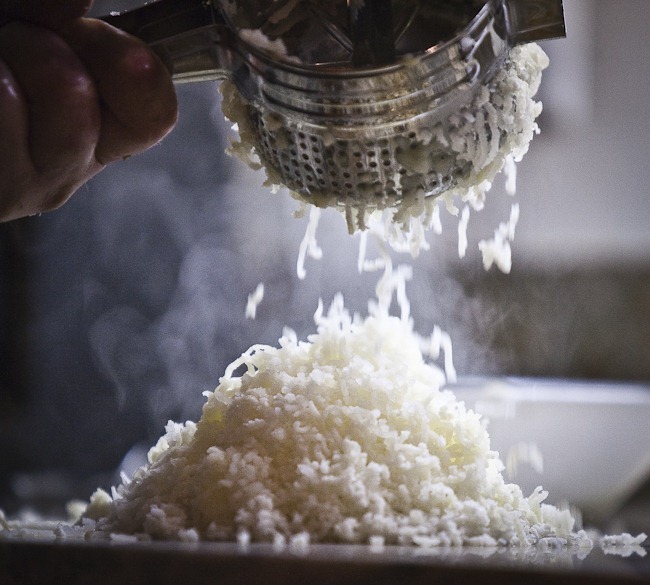
Activity always makes shots more interesting.  This can be a challenge in food photography, but yet possible.  A spoon stirring in a pot.  Steam rising off a freshly cut loaf of bread.  A knife slicing through a piece of meat.  Flames from a grill.  Use your imagination, I am sure you can find some activity (or at least the appearance of activity) to bring to the food.
Potato Ricing

Tip #5:  Eat Well

I don’t know about you, but ply my culinary skills for the purpose of eating it.  This implies two things.  First, organization and timing are key.  If you are cooking a dish, plating it attractively, photographing it, and still want to eat it (and not upset your dinner company), you need to think out the process ahead of time including pre-staging any lighting, props, wine glasses etc.  If you do all this, you can still eat well.  Professional food photographers generally do not have this end in mind.  They are intent on making the food look as good as possible and use a number of tricks to make food look more attractive such as misting or brushing oil onto the food to make it appear juicy and glisten.  Not me – the photography is standing between me and a great meal.

The second implication is that you will need to plan your shots – visualizing them before setting the plate down and clicking the shutter.  This is good practice independent of the photographic subject, but particularly important if you want to make a good photograph and yet eat while the food is hot.

Lamb and Cauliflower Puree

Come back soon for the next installment of food photography tips.  I have a whole pocket full.

Have fun, and go make some great photography.

Craig

Monday, February 14, 2011

The Beauty of Minimalism–Just a Little More

Rowers

As a follow-on to my last couple of postings “The Beauty of Minimalism” and “Three Eggs over Minimalism” this article wraps up my minimalism “finds” discovered while finishing up the post processing of 2010 photographs.  Like the photographs in the first article, the these feature simple subjects without distracting elements in the balance of the composition.

Aqaba Clouds

An interesting question to ask with respect to minimalist photography is “what do you experience when you look at the photograph?”  More specifically, what do you experience in contrast to viewing non-minimalist photography?  I find my personal reaction interesting.  Even more so than a “normal” composition, with minimalist photographs I find myself completely drawn into the scene.  I wonder what the artist saw.  I search the details of what little there is to discern.  I wonder why the composition works.  In other words, minimalist compositions raise a bunch of questions…which draw me into the work to a much deeper level.

Bill Landing

Finally, I find the minimalist approach refreshing after viewing so many photographs that are overflowing with activity, textures, color, and general distractions.  If you have read any of my past articles on choosing black and white over color, you will see a trend – for me, many times color means distraction from my predisposition to simplicity.

IMG_2009

So here is my challenge to you.  Go shoot something simple.  Then enjoy it.

Have fun, and go make some grate photography.

Craig

Wednesday, February 9, 2011

The Beauty of Minimalism

Circling the Sun-1
Some of the most visited articles I have posted are those featuring descriptions and examples of a minimalist approach to photographic composition.  I won’t list all the articles here, but if you search on minimalism in the handy search bar at the top left corner, you will find them quickly.
Fishing in the Grand River
In addition to responding to your “voting by visits,” I have a second reason for more minimalism posts – I found more photos that fit the genre.  More precisely, I had a milestone event yesterday when I completed the processing of all 2010 photographs.  While this may not seem a big deal, I completed 2009 in July of 2010.  During my processing of the final photographs for 2010, I found a number of minimalist photographs.
Sky Tow
Each of the photos in this series features the common theme of a simple subject and an uncluttered background.  This form of minimalism uses composition to eliminate or minimize distracting elements thereby giving the subject the opportunity to take the spotlight without competition.
Practice Green
Visit again later this week for another visit with some minimalist photography.
Have fun, and go make some great photography.
Craig

Monday, February 7, 2011

Photography Without Commentary

Sometimes, it is better to let the photography speak for itself.

Insect Porno

Have fun, and go make some great photography.

Craig

Monday, February 22, 2010

Petra in Motion

Petra in Motion
The entrance to, and the general location of, Petra Jordan is a wadi (dry watercourse).  As you proceed from entrance to the the far end of Petra (about 4km) you traverse a deep gorge portion of the wadi that gradually transitions to a broader and flatter dry bed.
I find these gorges very interesting; formed by thousands of years of water gradually eroding the softer portions of the stone, they are natural artwork and document the motion of water that created them.  This motion recorded in the walls of the gorge is the foundation of the featured photograph for this entry..  The motion of the water  is not difficult to imagine given the perspective and lighting in this photograph.
I intentionally set up this shot as a longer exposure to capture the motion of both the horse-buggy combination and the person walking away from the camera.   These little buggies regularly run up and down the wadi transporting tourists that don’t see walking through a wadi as good opportunity for exercise.
A fourth, less obvious element of motion are the channels on either side of walls.  These channels are man made and were designed to carry water through Petra…yes, the public water works.  These small canals that snake through Petra are a true engineering marvel.
Finally, I offer a second version of the same photograph.  This one in color.
Petra Jordan-5-2
As most of you know, I generally prefer black and white.  In this case, I prefer the black and white not for the many reasons I have mentioned before, but because the black and white version is more convincing in telling the story of motion.  As a color photograph, I am pleased; the orange shades of the rock walls provide an interesting background, and the green and red of the backpack and buggy canopy lead the eye through the photograph.  The simplicity helps as well; three subjects (walls, buggy, person walking) with three complimentary colors.  Although there is a great deal of shape and shadow, the photograph remains uncluttered.
There is a great deal more to come from my trip to Petra.  Please come back to see the rest.  Although I have to admit to being terribly behind on my photo processing and it may be quite some time before we have the chance to talk about the best from that trip.
Have fun, and go make some great photography!
Craig

Tuesday, December 8, 2009

Southern Maryland Barns in the Fog

Barn in the Fog-Edit
This entry is a continuation of my Thanksgiving Fog post.  The Thanksgiving fog post featured photographs on or near the water under the cover a dense fog over the entire DC metro region on Thanksgiving.
Barns in the fog-2-Edit
This post features photography from the same day with the exception of shifting the theme from “on the water” to fields and barns.
Barns in the fog-Edit
There are several aspects to each of these photographs I find appealing.  First, the fog provides a uniform background to each photograph that provides an interesting contrast to the foreground.  Notice that in each photograph there is a great deal of detail and good contrast on the immediate foreground.  The detail and contrast gradually diminish as your eye travels vertically through the photograph.
Farm in the fog-2-Edit
Another common attribute, other than barns and fields,  is that some portion of the photograph fades into the fog.  I naturally find myself studying the photograph and wondering “what is that, or what lies just beyond the threshold of the fog?”  This intrigue is a valuable component of the composition.
Farm in the fog-3-Edit
In nearly each of the photographs there is some grain of the field (rows of corn residue) that acts as a leading line drawing your eye through the photograph and eventually into the void created by the fog.
Farm in the fog-Edit
Another common aspect is the composition.  In each of these photographs I have placed the horizon (or what we can best make of it) at or around the upper 1/3 line.  In this type of environment, that makes most sense.  Imagine the horizon a the lower 1/3 division; the composition would be dominated by the nothingness of the fog and offer much less interest.
Horses in the Fog-Edit
Finally, each of these photographs reminded me I need to clean the sensor on my camera.  The opaque gray of the fog did a brilliant job of highlighting every speck of dust on my camera sensor.  I was not particularly happy with the time it took to repair each of these spots.  Gratefully, the dust spots are not featured in the final product.
Go find some fog and make some great photography!
Craig

Friday, November 27, 2009

Thanksgiving Fog

Tall Timbers in the Fog-2
The Washington DC area woke up to a dense blanket of fog on Thanksgiving.  I had made no plans to shoot that day, but with the amazingly luscious fog, I had no choice but to pack up the camera and take advantage of this beautiful event.  Sometime in the future I will post another entry on how weather affects my photography and my choices to shoot; it plays a big role.
Dock to nowhere
The photographs featured in this post all come from Southern Maryland and will likely contribute to my ongoing project of On the Water in Southern Maryland.  I am naturally drawn to water related photography, but the gift of Thanksgiving fog made my morning of shooting that much better.
Bridge into the fog
In my opinion, photography that features fog as a prominent component makes the question of color vs. black and white a non-decision.  The fog generally introduces a gradual transition in black and white tones that I want to feature without the distraction of color. 
Boat in Saint Mary's
Fog offers a number of advantages; diffuse soft light, a mood of solitude, mystery, and it evokes a sense of inquisitiveness in the subjects that are either partially obscured or causes to fade into the distance such as the photograph of the bridge.
So here is my recommendation; if you see fog, strap on the camera, and shoot!
Have fun, and make some great photography!
Craig

Monday, November 23, 2009

Minimalism Part IV – Land and Sky

Merida Valley - 2
The first two posts in this four part series focusing on minimalism in photography featured water related photographs.  In this final post I am featuring land and sky as a balance to my natural nautical affinity.
Abu Dhabi Desert Landscape (6 of 6)
I believe that landscape photography works well within the context of minimalism to the extent that the landscape is not terribly complicated.  In other words, lots of trees and other vegetation coupled with bold landscape feature introduce clutter and detract from a minimalist perspective.  The following photograph of the Arizona desert is an example of the tendency away from minimalism.
Desert Mountain Panorama on Organ Pipe Cactus National Monument
The next photograph is much more minimalist with only a wind turbine blade and the hint of hills on the horizon to give context to the sky.
NREL Windmill Wing Big Sky
The next photograph is minimalist on a number of levels.  First, the fog helps blend the mountains and the sky – softening a lot of the features.  What is less obvious is what this photograph really means.  If you look closely at the mountain peak on the left you will see the snow pack.  This is Pico Bolivar, the highest point in the Venezuelan Andes mountains at over 16,000 feet above see level.  Pico Bolivar is home to three small glaciers, the last in Venezuela.  And they are shrinking rapidly.
As Andean glaciers and snow pack disappear, water will become an increasingly serious issue for Venezuela and Colombia.  Among the many functions glaciers and snow pack serve, there are two that directly affect the safety and security of Venezuela and Colombia.  First, the glaciers and snow pack retain water and distribute it for irrigation and drinking at a steady rate throughout the year.  Clearly this is important for both human/animal survival and the ability to grow crops. 
In a related matter, the water retained in the glacier and snow pack controls flooding.  In other words, moisture is captured, stored, and released gradually.  Without this storage function, severe flooding and erosion will threaten both counties.
Merida Valley - 3
I don’t want to make this entry too long, so I will leave the remaining three photographs for your enjoyment without commentary.
Plain at Boulder CO

Solomons Bridge-2

Tucson Desert Sky
I hope you enjoyed this series and would love to hear your feedback.
Have fun and go make some great photography!
Craig

Wednesday, November 18, 2009

Minimalism Part III – Simple Subjects

Ella's Wagon
Welcome back to the third in a four part series of posts addressing minimalism in photography.  In the first installment, I talked about a definition of minimalism applied to photography.  In the second installment I tried to further define minimalism by contrasting to its opposite.
Bukha Fort Oman - 4
In this post I will look at one case of minimalism as I have defined it – a composition with simple (or no) subjects.  I’m sure you get the idea of a simple subject, and most of these photographs are reasonably good examples of this, but what about a photograph without a subject?  Is it possible?  Take a look at the next photograph and make your own conclusion.
NREL Atrium Light
I will admit that it is possible to make the argument that the light is the subject.  However, we perceive light in two ways; directly (from the source) or by reflection.  In this case, you have the source (1/3 bright white circle at the top center) and the reflection (the balance of the composition.  In this case, both the source of the light and the reflection are nearly formless.  So what is the subject?
The subject in the next photograph is much clearer.  The camel emerging from the fog is clearly the subject of this photograph.  But with the fog obscuring nearly everything other than the camel and the rails to either side, we are left with in a rarified atmosphere with little left to focus on than the camel.
In the Lead
The next photograph are of the columns of the Jefferson Memorial in Washington DC.  By introducing a blur to the photograph (Lensbaby Composer) and keeping the spacing between the columns tight, the result is a greatly simplified subject.
Jefferson Memorial-3
The next photograph comes from Machu Pichu, Peru.  The leading lines of the terrace lead the eye to a small building on the edge of the mountain…like the camel emerging from the fog.  Again, the fog offers a great way to simplify the composition, remove distracting background elements, and leave the composition with a very simple subject.
Machu Pichu - 39
Finally, the last shot of paragliding in the Venezuelan Andes is a perfect example of a simple and isolated subject.
Parapente in Merida - 3
Up next; the fourth and final minimalism entry.  The final entry will feature sky and mountains as examples of minimalism.
Have fun, and go make some great photography!
Craig