Showing posts with label Chicago. Show all posts

Tuesday, May 1, 2012

Chicago


This past weekend was spent in Chicago attending the wedding of good friends Nora and Michael.  While there, we did plenty of hiking around the city searching out some of the great food the city has to offer.  Of course I could not pass up the opportunity to haul around my camera and take some shots of opportunity.


Chicago is a city proud of many things, not the least of which is its architecture which provides great targets of opportunity for anyone walking about.  On our second day in Chicago we ventured out to Oak Park to visit the home and studio of Frank Lloyd Wright and the birth place of Ernest Hemingway.  I will focus on the visit to Oak Park in future posts, but for now, here are a few of my photographs from our walk around Chicago.


Have fun and go make some great photography.

Craig

Wednesday, April 28, 2010

What do Chicago and a Venezuelan Beach have in Common?

 Chicago Street with Corn Cob
What do Chicago and a Venezuelan beach have in common?  They are both hanging on my walls.  This post is a continuing response to requests asking what photos I display in my home.
I printed both of these photographs on 36” x 24” canvas and have them hanging side by side.  I chose the combination because the subjects are completely unrelated, yet when placed side by side you see elements of one reflected in the other.
Sandscape on La Orchilla
We arrived at the beach in this photo, located on La Orchilla, early in the morning.  The beach was flat and smooth.  By the end of the day, the sand was churned up like a well plowed field.  As the sun neared the horizon later in the day, shadows were cast across the crests of the disturbed sand.
When I chose these photos, I saw the shadows in the sand reflecting the windows and shadows in the Chicago photograph and enjoyed the way that two completely dissimilar images complimented each other.
Have fun, and go make some great photography!
Craig

Thursday, November 5, 2009

Diptyches in Photography

Chicago Street with Corn Cob La Orchila Sand
A photography diptych is a combination of two adjacent images  to form a single artistic statement.  Most commonly, diptyches are found in the side-by-side format (probably due to the historical foundations of diptyches…Google diptych, or go to Wikipedia if you are interested in the history), but work equally well in an over-under form.
Salto Sapo - 1
AF Memorial sillouette
I originally brought up the idea of diptyches in the context of one of my ongoing projects - (Un)Focused on DC.  This project is based on the form and light of Washington DC with a distinct lack of focus – camera focus.  As I began to collect photographs, I was increasingly happy with the results, but I felt a hint of discomfort.  I concluded that a full collection of unfocused images was too much of a good thing.  I then decided to proceed with the project using diptyches.  Specifically I am matching focused and unfocused shots to create an artistic statement.
Caracas Barrio Highlight Ants
The diptyches featured in this post are not from the (Un)Focused project, but I do intend on sharing some of these soon.  These pairs are presented to illustrate the concept of a diptych.  I am very attracted to the concept of a diptych and frequently use it as a way  arrange the photographs on the walls of my home.  The first group is an example of a pairing you will see upon entering my home.
Chicago Egg
Hirshorn Museum 3 of 6
One of the great things about diptyches is that the combination of the two photographs is frequently much more interesting than either as an independent photograph.  In some cases, a so-so photograph can become very interesting in combination with another.  I think the previous grouping is a good example.  The Chicago millennium park photograph on top is an interesting photograph.  The Hirshorn museum photograph below it, less so.  In combination, the Hirshorn and the Chicago photographs become much more interesting.
Minaret on Black Sky Washington Monument with Moon-2
Sometimes the meaning of a diptych goes beyond the color, shades, and form.  Particularly true for diptyches, although the case for all art, the meaning can be negotiated.  The artist has intent.  The viewer interprets.  The interaction of the two positions creates interest.
Why Stop- Has anyone seen my lama
And who is to say that diptychs can’t be fun as well?
I hope you enjoyed the photography and yet another way to extend your creativity and enjoyment of photography,
Have fun and go make some great photography!
Craig

Thursday, June 25, 2009

Repeating Patterns

Stairs at ADNOC
In a recent post, the subject matter was reflections.  I suggested we find reflection captured in photography appealing, for one reason, because it introduces an element of repeating patterns.  I don’t pretend to understand the brain’s hardwiring or psychology that leads to this affinity, but I know it is true.  Even mundane subjects such as golf carts, become interesting when they are aligned in a way to present a series of repeating patterns.
Golf Carts
The next shot is of the famous “Corncob” apartments in Chicago.  As I look at this shot, my eye first sees the shot as a whole.  My gaze then starts to wander and marvel at the symmetry and repeating corncob “holes” representing each of the apartments.  Then I become more curious and begin to explore what is going on in each of those locations – there is a great deal of detail to attract the eye.
Chicago Corn Cobs small
The next two shots come from Washington DC and include Arlington National Cemetery (actually in Arlington Virginia) and the Washington Monument.  For those of you looking for some shots with repeating patterns, Arlington National Cemetery has a nearly infinite number of ways to compose photographs with repeating patterns that extend to the horizon.  I am particularly fond of shooting at Arlington in the winter – and in black and white; the starkness adds to the solemn nature of this revered location.
Flag Ring at Washington Monument
DCF 1.0
The next two shots both come from Innsbruck Austria and represent two very different forms of repeating patterns.  The first shot of church pews is similar to Arlington National Cemetery in that it is not only a set of repeating patterns, but also takes advantage of another photographic technique – leading lines – that I wrote about in a previous post.  The second shot uses repeating patterns to bring interest to the composition, but does not use leading lines to guide the observer through the photograph.
Innsbruck Church Pews
Innsbruck Crosses
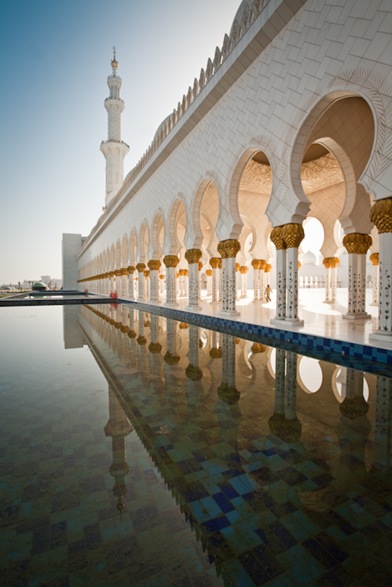
The next shot comes from the Sheikh Zayed Bin Sultan Al Nahyan Mosque in Abu Dhabi, UAE. 
Columns
Finally, I will leave you with a preview of yet another future blog – Machu Pichu, Peru.
Machu Pichu - 34
I hope you enjoyed this post.  I also hope you get outside, take some shots, and look for repeating patterns to add interest to your photography.
All the best,
Craig

Tuesday, June 16, 2009

Reflections

Hirshorn Museum 5 of 6
Capturing reflection is a fun and creative part of photography.  Photographs that incorporate reflection are appealing on multiple levels.  But as I was conceiving this post I had to ask “why?”  I know I enjoy shots that take advantage of reflection, but simply acknowledging the affinity is not a sufficient explanation.  To answer the question, I decided to gather the shots for this post and analyze them…what specific elements of the shots created interest, drew the eye, and why. 
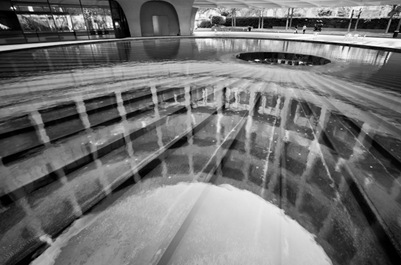
The first shot (above), is an example of reflecting something that is not actually in the frame.  All told, this is a more complex form of using reflection.  The composition is dominated by the water feature at the center of the Hirshorn Museum in Washington DC.  However, in addition to the water feature, we see the reflection of the Hirshorn museum proper.  I find this shot particularly appealing because unlike most water reflected shots, the water feature has it’s own texture and depth.  The reflection of the interior walls of the Hirshorn is overlaid on the beams or channels that span the water feature, just below the surface, leading to the large hole where the water drains at the far side.
Now contrast the first shot of the Hirshorn with this one:
Hirshorn Museum 6 of 6
This is essentially the same shot, but the composition was expanded to include the interior walls of the Hirshorn rather than just reflecting the walls.  This composition introduces what I have concluded is the second way reflections add interest to a shot; repeating patterns.  Our eyes are naturally drawn to repeating patterns.  I can’t explain why we are attracted to repeating patterns, but I know it to be true.
The next photograph, from the Thames River in New London, CT, is another example of the appeal brought by repeating patterns.
Swan and Sailboat in the Mist - 2
We can differentiate some of the elements of this photo to further distinguish what we find appealing.  In this shot, the reflection is primary limited to the two principal subjects in the shot; the swan and sailboat.  Other features such as the far shore and a house emerging from the fog do not have reflections.  This results naturally in your eye falling on the sailboat, then moving to the swan, and eventually to the fog shrouded shoreline in a clockwise manner.
Now contrast the swan and sailboat with this shot of Mystic Harbor in Mystic Connecticut.
Mystic Lighthouse
In this case, the reflection runs the width of the entire composition; everything has a reflection.  If you notice how your eyes move through this shot, you will likely find that you pick something of interest such as the lighthouse or the tall ship, then your eyes will move horizontally along the waterline to take in the rest of the shot.
Returning, to the reflective form that brings something to the composition from outside the frame, this shot from Millennium Park in Chicago is a great example.
Chicago Egg
In addition to the skyline brought into the composition by the reflection, I like having a person standing under the “egg” to provide some scale to the shot.
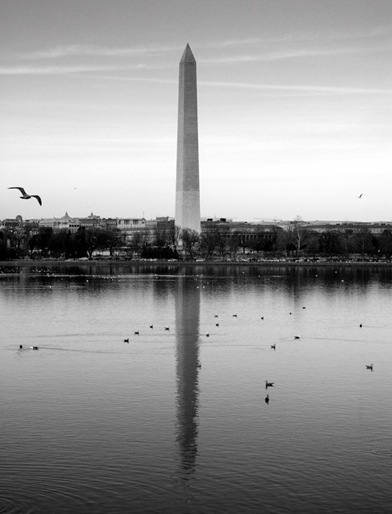
Water is the most common surface for compositions using reflection.  Naturally, this leads to many nautically themed photographs.  The next four shots are exceptions to the nautical them and use reflecting pools (U.S. Capitol and of minaret of the grand mosque in Abu Dhabi) and the tidal basin in the case of the Washington Monument and the Jefferson Memorial.
DCF 1.0 
Domes from Exterior-2
Washington Monument Refelction-2
Jefferson Memorial Reflection-2
The next group of shots focus on animals and water reflection.  Specifically, a shot of retriever entering the water with perfect form, and a pair of swan shots.  Notice with the shot of the swan and the boat how the swan mimics the boat.
Retriever at Maritime Museum - 2
Munich Swans
Swan and Sailboat in the Mist - 1
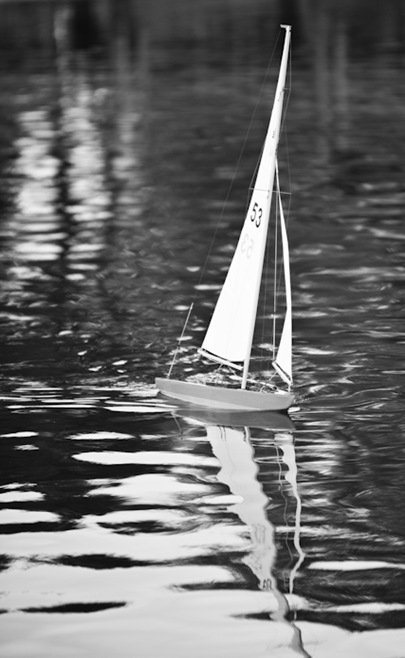
Finally, I will leave you with two nautically themed shots.  The first is of a radio controlled sailboat in the boat basin of the Calvert Marine Museum in Solomons, Maryland.  The second comes from a fog enclosed marina in New London, Connecticut.
RC Sailboat 53 - 1
New London Marina - 1
I hope these examples of reflections in photography are helpful in understanding their appeal.  So the next time you are composing a shot with a reflection, try to understand how the reflection adds interest by either developing repeating patterns, or by adding to the composition something that is not directly in the frame.
Enjoy!
Craig

Sunday, April 5, 2009

Urban Portraits

This entry is inspired by my son Ryan.  After reading the first couple of entries, Ryan requested that I feature some photography from the “Urban Portraits” theme I have been developing.  In requesting this, Ryan motivated me to talk about two things.  First is the idea of selecting a photographic theme, then pursuing it.  Second, I have employed some specific composition and editing techniques to get the results I envisioned for the theme of Urban Portraits.


All of the shots in this entry are building on the theme of “Urban
 Portraits” I began pursuing in 2005 – roughly four years ago.  Clearly, I am in no rush.  The relevant aspect of talking about urban portraits is that I have selected a theme that interests me, and I am pursuing it – and, as we say in Spanish – poco a poco.
  
Little by little I am adding to this collection.  I find that selecting a theme for a project, whether short term or long term, helps focus attention, energize creative processes, and always provides an answer when you find yourself asking “what should I shoot today?” Selecting a theme also highlights the value of planning your shooting.  There is a significant difference between planning a shoot and simply waiting for lighting to strike.  Don’t misunderstand me; I have plenty of spectacular shots that resulted from nothing more than the luck of being in the right place at the right time.  However, planning to get the shots you want can be an invigorating challenge.


The first two shots in this entry feature my son Ryan.  He gets top billing in this entry as a nod to his request for the urban portraits.  We had a great time setting up these challenging shots, and I had an even bigger challenge in post processing.  Both of these compositions involve multiple shots.  To get these shots, I set the camera on a tripod, set the ISO to the lowest setting, and used a very aperture.  The result was exposures of up to 2 seconds, and the “ghost” images of passersby as Ryan held his breath and kept completely still.  To get the right mix of “ghosts” I took several shots and then combined them in Photoshop to get a good balance of people in motion.


The second shot involved additional post-processing to keep Ryan in color and add even more of a ghostly effect by converting the rest of the photo to black and white. Which brings me to a second theme among my urban photography shots; by keeping the subject in color and converting the balance of the composition to black and white, you bring clear focus to essence of the shot while introducing a bit of impersonal grittiness often associated with the urban environment.  The Chicago sax player and the Quito street juggler are good examples.  
When I say “street juggler” I mean it literally.  

It is common for street performers to practice their talents in the middle of the street while lights are red in hopes of getting a donation for their public service.  When you look at the picture, where does your eye go tend to settle?


The next two examples take this a step further.  By de-saturating the color, increasing noise, increasing sharpness, accenting highlights, softening the area away from the subject, and deepening shadows, you can add another level of urban grittiness.  “Orange Beard” and “Jose Tucson” are two examples…which is which should be clear.


The next two shots of a man and a woman on the streets of Quito, Ecuador, are similar in the approach taken, but without the color de-saturation.  One of the common photography practices used in both these pictures is limiting what the viewer can see and allowing the mind to complete the image.  In the case of the man, you can see a very shallow depth of field that includes little more than his face.  Much of his hat is out of focus and out of frame, and his shirt and jacket are not in the focal plane.  In each case, this leaves a number of holes for your mind’s eye to complete.  Although you are not “seeing” a full image, your mind is completing it and therefore not confused or unsettled about the missing pieces.
Man in Quito:


The Woman in Quito shot takes a similar approach with a shallow depth of field, parts of the hat and shoulders out of frame, and her head is tilted down so the eyes are not visible.  Like the “Man in Quito” shot, your mind automatically fills in the holes.  The point I am trying to make is that it is not necessary, and frequently undesirable to have the entire subject of your photograph well within the bounds of your shot.  Engage the interest of your viewer by letting them do some of the work!

Woman in Quito:


The final two shots, as most good shots, have a great story behind them.  We will call the subject of the shots Pedro.  Pedro is a very interesting man that tells a great story.  Pedro is in his 90s and is a neighbor of mine.  I first met Pedro as I sat one night on my front porch having a cigar and a scotch…I heard love ballads sung in Spanish drifting through the night air of my neighborhood.  As time went on, I spent time chatting with Pedro…fortunately I speak Spanish, because Pedro does not speak English.  Pedro is Cuban-American and came to the U.S. some 40 years ago.  Pedro is still on his game and willing to tell stories of Cuba and his experiences over his last 40 years in the U.S.

From a photographic perspective, these shots are all about the years of experience revealed in Pedro’s eyes and even more so in his work worn hands.  Like the Quito shots, both of these shots employ a very shallow depth of field limited to little more than Pedro’s face.  Looking at the second shot, you see how the background is completely blurred, while the foreground, as close as his hands, is also blurred.

As always, I hope you enjoyed these photographs and in the process learned something.  If you have any requests, or questions about photography, please send me a note.  I will be happy to share my opinion and the benefit of my experience.
Craig