Showing posts with label Oman. Show all posts

Tuesday, August 31, 2010

Abandoned Village at Al Nuway Oman

Abandoned Village at Al Nuway Omman-5

This is the last in my series of posts featuring the fort and abandoned village in Al Nuway Oman.  My last post in the series “Fort at Al Nuway Oman” focused on the fort while this post feature photography of the abandoned village immediately adjacent to the fort.

Abandoned Village at Al Nuway Omman

The five photographs featured in this post share two things in common aside from the subject matter.  Each is an HDR photograph, and each composition was made from a direction having the sun in the background.  Unless you are trying to compose a silhouette, shooting into the sun is not a recommended practice.

Abandoned Village at Al Nuway Omman-1

The results of shooting into the sun usually end up with one of two results; a) your subject is exposed well, but the background is completely blown out (over exposed), or b) the background is properly exposed and your subject is under exposed.  With such a dramatic contrast in light levels, it is quite difficult to get a balanced exposure when shooting into the sun.

Abandoned Village at Al Nuway Omman-2

By using HDR techniques (post processing combination of multiple exposures with shots a couple of stops under exposed, and over exposed) you can overcome the exposure balance limitations inherent in shooting into the sun.  When you look at a scene with the sun in the background, your eye is able to adapt to the harsh light differences – your camera is not as sensitive and cannot do so in a single exposure.

Abandoned Village at Al Nuway Omman-3

I hope you have enjoyed this trip to Al Nuway and along the way picked up a couple useful applications of HDR photography.

Have fun and go make some great photography.

Craig

Saturday, August 28, 2010

Fort at Al Nuway Oman

Fort at Al Nuway Omman-1
In February of this year, I posted two entries featuring a trip I made with my good friend Steve to Oman (Oman - a Fort, A Wadi, and Falaj, and Oman Part II - Al Nuway and Khutwa).  Since posting these entries, I recently spent a bit of time processing more of the photographs and even taking a second look at some of the first few I processed.
Fort at Al Nuway Omman-2
The photographs in this post all feature the fort at Al Nuway.  I tried doing a quick bit of research on the fort, but when googling it, the first articles that came up, were my previous posts on the subject.  Obviously not terribly helpful in shedding new light.
Fort at Al Nuway Omman-3
But here is what I can say through observation; the fort likely served the purpose of collecting customs duties as well as defense.  In this part of the world, the wadis (dry river bed) often form part of the network of ancient trade routes.  I’m guessing the reason for this is that they are generally more level and easily passable than the surrounding terrain and also provide an occasional source of water in a very dry region.  I may be completely wrong, but wadis appear to be the path of least resistance when traveling.
Fort at Al Nuway Omman-4
If you take the time to compare the processing of these photos with the original posts (Oman - a Fort, A Wadi, and Falaj, and Oman Part II - Al Nuway and Khutwa) you will see a dramatic difference.  In each case, the photos are HDR photography.  The difference is that my taste and experience with HDR photography has matured quite a bit since the original posts.  I have learned that unless I am intentionally going for a particularly dramatic look and feel (see Bridgespot Collection 1, and Bridge Spot Collection 2), it is best to apply the tone mapping tools of HDR processing judiciously.
Fort at Al Nuway Omman-5
I hope you enjoyed the return trip to the Fort at Al Nuway Oman.  If you or a friend happen to know more about the fort, it’s history, and purpose, please send me a note at craigcorl@yahoo.com.  I would be happy to share more information about this beautiful location.
Have fun, and go make some great photography.
Craig

Monday, February 15, 2010

Oman Part II: Al Nuway and Khutwa

Gardens at Khutwa-3
This is my second set of photographs from Al Nuway and Khutwa Oman.  See “Oman – A Fort, A Wadi, and Falaj” for part one and some context for these photographs.  In presenting these photographs I am breaking one of my closely adhered rules – keep the collection consistent…in as many ways as is possible.
House at Khutwa
In other words, one aspect of consistency is my preference to present a set of all color photographs in a collection, or a set of black and white.  Mixing the two tends to confuse the collection and detracts from the feel or story told as a group of related photographs.
Window at Khutwa
There are probably times when there is good reason to combine black/white and color in a single collection.  There may be an element of contrast, or a part of the story that is best told in either manner of presentation.
Door at Khutwa
This small collection fits no good “general” reason that I can think of for mixing color and black/white.  So why did I do it?  Simply put, I liked the flow of the photographs.  The road in the second photograph mimics the flow of vegetation in the first photograph.  the window in the third flows from the window in the second.  Moving from a dilapidated window to the door of an abandoned home is an easy transition.  Finally after zooming into a window and a door, we take a step back to see everything in context.
Fort at Al Nuway Omman-2
I have no idea whether this logic makes sense to you, but it worked for me in putting this small collection together.  And although I have mixed color and B/W in a single collection, I think it still works.
Have fun and go make some great photography.
Craig

Saturday, February 6, 2010

Oman – A Fort, a Wadi, and Falaj

Steve at Al Nuway Fort Omman
This weekend, a very good friend of mine, Steve Duffy (seen in the first photograph) and I went on a day-trip to Oman for yet another photographic adventure.  We visited a number of places in Oman near the border with the UAE.  We visited Al Nuway, Khadra Wadi, Wadi Sharm, and Khutwa.
Fort at Al Nuway Omman
I had a wonderful day and made over 500 exposures.  With the limited time I have recently been able to dedicate to post processing, it looks like I am digging my hole even deeper.  Today I was able to sneak in a couple hours of processing so I could at least share a few photographs with you.
Khadia Wadi
So, to explain the title of this blog, I need to provide a couple of definitions.  Wadi is an Arabic term for a dry river bed or stream.  Of course, during rains, a Wadi will collect and convey great volumes of water collected from their mountain sources.  Sometimes the flow of the wadi is sufficiently strong over time to cut gorges through rocks.
Gorge at Khutwa Wadi
The second definition, for Falaj, is a system of canals to convey water from a remote source to the point of use.  The Falaj at Khutwa shown here begins several kilometers up into the surrounding mountains and has an elaborate system of gates and tiers to bring water to any of the hundreds of garden sections.
Gardens at Khutwa
With over 500 exposures, I have plenty more to share from this trip to Oman.  I promise to post more soon.
Gardens at Khutwa-2
Have fun, and go make some great photography.
Craig

Thursday, May 21, 2009

What’s in the Bag? (17-40 f/4.0 L)

I feel very fortunate to have inspired a number of friends, colleagues, and acquaintances to either pick up a camera and pursue photography a bit more deliberately, or to rekindle an old flame.  I intentionally did not use the phrase “take photography more seriously” because, I firmly believe it should not be taken too seriously.  Photography is a great joy and like anything else taken too seriously, can loose it’s sparkle if not approached with the freedom and expression the endeavor calls for.  Photography is a pursuit that should be a release for the creativity one desires to express and in doing so should be an avenue of great pleasure.
But this posting is not about the joys of photography.  In this post I intend to answer the question “what’s in the bag?”  More specifically, I will tell you what gear I use, the benefits and limitations of that gear, and how it helps me get the shots I see even before the viewfinder comes to my eye.
Before I open the bag, I think it is important to add a disclaimer to this discussion.  I have a whole bunch of really nice gear.  In fact, there are a number of people who make their living in photography that do not have such a well equipped kit.  I recognize my good fortune and do not take it lightly.  However, it is not the equipment that makes good photography.  It is the photographer. 
Before I built up my kit, I collected a very nice portfolio of shots taken with equipment much less capable.  If I were to post the best shots taken with my original canon EOS and kit lens alongside those taken with a $3000 body and $2000 lens, it would be difficult to judge from which camera the shot originated.
In summary, the best camera to have is the one you have in your hands when the stars align and a beautiful composition is begging you to click the shutter…even if it is the camera on your phone.
In this post, I will give a brief description of the camera body I use, and the shortest focal length lens I have.  In later posts I will work through the rest of the bag.
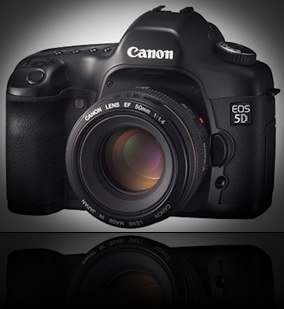
Canon 5D
Canon 5D
I shoot with the Canon 5D digital SLR (Single Lens Reflex).  This camera was recently replaced by the Canon 5D Mark II and is no longer in production (yet still available, and a great value on the used market).  The principal advantage of the 5D is that it has a full frame sensor as opposed to the cropped frame sensors of the rest of the Canon line (with the exception of certain 1D models).  In terms everyone can understand, the sensor that captures the image on the Canon 5D is essentially the same size of a 35mm film negative.  Cropped sensor bodies use a smaller sensor meaning less physical space on which to capture the image.  The difference should be clear; the larger the sensor, the more information can be captured.  More detail, more color information, and greater light sensitivity.
For a full review of this body (or anything else in the canon line), I highly recommend going to The Digital Picture.com produced by Bryan Carnathan.  Bryan publishes some of the most thorough and well written reviews you will find.  For the Canon 5D, follow this link: 
www.the-digital-picture.com
/Reviews/Canon-EOS-5D-DSLR-Digital-Camera-Review.aspx

Canon EF 17-40mm f/4.0 L USM
Canon 17-40
This lens is the bottom of the Canon focal length zoom lens range.  This lens is an ultra-wide angle lens in the Canon L series.  There are other fixed focal length lenses that have a shorter focal length, but none among the zoom lenses.  At the shortest focal length, this lens can fit a great deal of real estate into the frame.  From a landscape perspective, the next three shots of a fishing village near Al Jadi, Oman (first two) and Hana Oman (third in the series) are examples of what this lens can do at the 17mm end of its range.
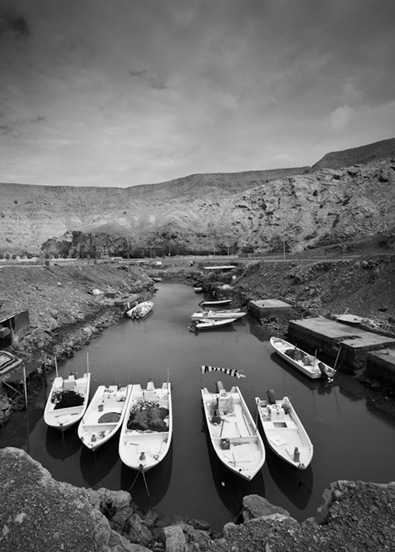
1 Fishing Village Near Al Jadi Oman
2 Fishing Village Near Al Jadi Oman - 2
3 Fishing Village of Hana Oman
The next shot demonstrates one of the great applications of this lens.  The shot of this old car was taken about a foot from the front fender and was still able to cover essentially the entire car (and this shot was cropped a bet to eliminate some distracting elements on both the right and left sides).  IMPORTANT SAFETY NOTE:  it is not a good idea to take close up shots of people using the 17mm end of the focal range.  Your subject will be very distorted, and not in a flattering way.  For instance, a headshot of a person will result in a photograph with a dramatically enlarged nose…not a good way to win points with your spouse.
4 Ford sinking into the ground - small
The next two shots come from Bukha Oman.  Both these shots demonstrate the wonderful landscape photography that can be produced with this lens.
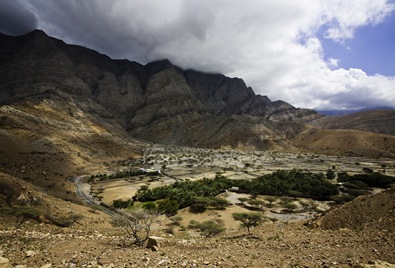
5 Bukha Oman - 2
6 Bukha Fort Oman - 4
I also find this lens perfect for architecture photography.  The next series of shots are from the Sheikh Zayed Bin Sultan Al Nahyan Mosque in Abu Dhabi, UAE.  Most are taken at the 17mm end of the range, but a couple come from the longer end of the focal range.
7 SAHN BW
8Minaret Reflection
9 Relief
10 Arches
11 Framed
12 Flowers and Minaret
13 Framed Minaret
I hoped you enjoyed this post.  In the next segment of “What’s in the Bag?” I will talk about the Canon 24-105mm f/4.0 L.  This is an indispensible lens that is attached to my camera more often than any other lens.  I also hope you enjoyed the photographs.
Saludos!
Craig