Some time ago I promised to dedicate a post to the Moko Jumbies of Trinidad. I am living up to that promise. There are plenty of sources that talk about moko jumbies, their history and purpose. So I will not attempt to do so, but will reference a brief article in Wikipedia later in this post.

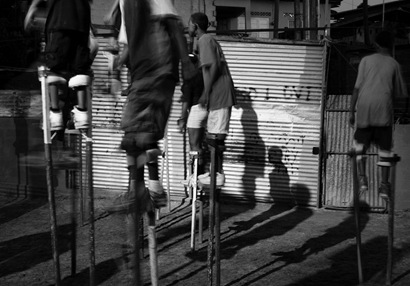
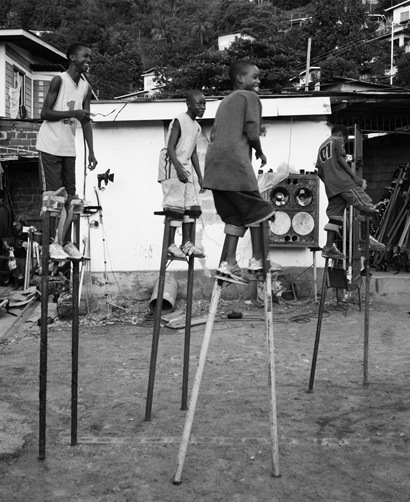
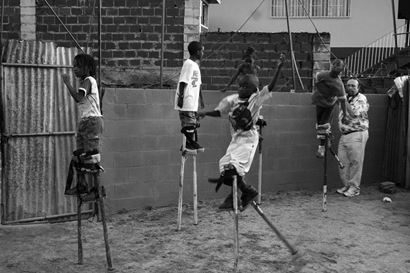
For my part, I will tell the story of Moko Jumbies in the form of my photographs and my interaction with them. All the photographs featured here come from a moko jumbie training yard on the outskirts of Port of Spain, Trinidad.

Quite obviously, moko jumbies are stilt walkers. In Trinidad, the moko jumbies train for their principal performance; Carnival. But the training is more complex than preparing for this unique Trinidad festival; it begins at a young age.

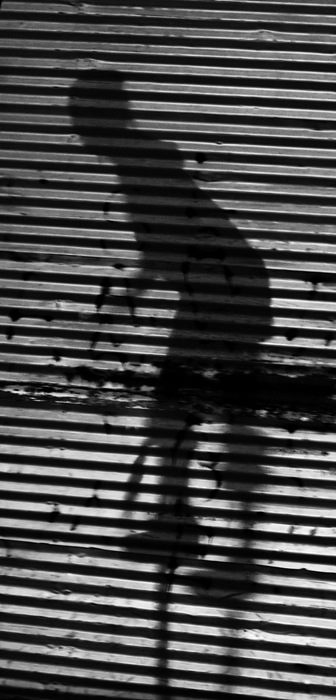
These photographs show moko jumbies as young as 6 years and as old as 14. As they grow older and gain skill, moko jumbies progressively graduate to taller stilts. The silhouette above is that of one of the advance moko jumbies that has to climb a utility pole to strap on and mount his stilts.
The moko jumbie yard I visited was fascinating. In addition to witnessing the whole process of mounting and practice, the atmosphere was perfect – the air was filled with ear splitting soca music. Because these are photographs rather than video, I will have to tell you that the moko jumbies are dancing to the music…not just walking around, but dancing!

Another great aspect of this experience was the joy of watching kids play. As is the case with any teenager, given the opportunity they will turn any circumstance into a game, a competition, or something completely different than adults might intend. The moko jumbies are no exception.

For the remainder of this post, I will give you some of the history of the moko jumbies according to concise article on Wikipedia.

The origin of the term may come from "Moko" (a possible reference to an African god) and "jumbi", a West Indian term for a ghost or spirit that may have been derived from the Kongo language word zumbi. The Moko Jumbies are thought to originate from a West African tradition brought to the Caribbean.
Moko, in the traditional sense, is a god. He watches over his village, and due to his towering height, is able to foresee danger and evil. His name, Moko, literally means the “diviner” and he would be represented by men on towering stilts and performs acts that were unexplainable to the human eye.

The Moko arrived in Trinidad by “walking all the way across the Atlantic Ocean from the West coast of Africa, laden with many, many centuries of experience, and, in spite of all inhuman attacks and encounters, yet still walks tall, tall, tall. (John Cupid, Caribbean Beat)”

The idea of the Moko survived by living in the hearts of African descendants during slavery and colonial life to eventually walk the streets of Trinidad in a celebration of freedom, Carnival. While this figure was rooted in African heritage, Trinidad adapted the figure, notably by adding on Jumbie or ghost to the name.
By the early 1900’s Moko Jumbies had become an element of Trinidad’s Carnival. This figure would walk the streets of Port of Spain and other cities protecting the city and revelers from evil. As part of his role in Carnival the Moko Jumbie would accept donations from onlookers in upper floors of buildings. However, his notable figure of Carnival slowly faded until a drastic revival.
By the early 1990’s Moko Jumbies were essentially non-existent in Carnival, until two men brought this tradition back. These men, namely Moose and Dragon, have brought the Moko Jumbie back to a place of prominence in Carnival and created a new kind of Moko Jumbie. One man originally brought the idea to them as well as the knowledge of how to make stilts. Now there are two main Moko Jumbie bands in Trinidad, Watusi and Kilimanjaro, as well as several smaller ones. So while the idea of the Moko came from Africa, Trinidad has made it its own.
I hope you enjoyed these photographs and learned something about the moko jumbies.
Have fun, and go make some great photography!
Craig


%5B4%5D.jpg "Moko Jumbies (37 of 37)")
%5B4%5D.jpg "Moko Jumbies (1 of 37)")
%5B4%5D.jpg "Moko Jumbies (36 of 37)")
%5B4%5D.jpg "Moko Jumbies (13 of 37)")
%5B4%5D.jpg "Moko Jumbies (34 of 37)")
%5B4%5D.jpg "Moko Jumbies (30 of 37)")
%5B4%5D.jpg "Moko Jumbies (26 of 37)")
%5B4%5D.jpg "Moko Jumbies (18 of 37)")
%5B4%5D.jpg "Moko Jumbies (31 of 37)")
%5B4%5D.jpg "Moko Jumbies (20 of 37)")
%5B4%5D.jpg "Moko Jumbies (21 of 37)")
%5B4%5D.jpg "Moko Jumbies (25 of 37)")
%5B7%5D.jpg "Moko Jumbies (29 of 37)")