
Over the last month I have focused almost entirely on food photography to support my food and wine pairing blog “Craig’s Grape Adventure.” Over this intensely dedicated period my food photography has improved tremendously and I have learned quite a bit along the way. A number of you have asked for some tips to improve your food photography, so over the next few posts I will share what I have learned. These are not presented in any particular order, so don’t interpret any of the tips as being more important than others.
Tip #1: Shoot Low – Angle Matters
One of the most uninteresting food shots I can imagine is one taken from directly over the plate – looking straight down. This type of shot takes away any notion of depth and just looks flat. At the other end of the spectrum, shooting horizontally “across” the food at 90 degrees is an approach that leaves you missing a lot of the dish. If you accept this premise, the “right” angle is somewhere between 0 and 90 degrees. Personally, I rule out everything above 45 degrees. My approach is to go as low as possible while still maintaining sight of the parts of the dish I want to feature. So here is the tip; start with your camera at completely horizontal, then continue to elevate it until you are comfortable with the composition. Most mistakes happen by shooting from too high an angle, so concentrate on staying low.

Tip #2: Composition Rules Work for Food Too
I’m not big on “rules” but nonetheless there are a generally accepted set of composition “rules” for photography composition. Those that I feel are particularly important for food photography are the rule of thirds, leading lines, simplicity, and texture. I won’t bore you with definitions here, but I reserve the right to bore you later. These topics have been beat to death by me and the rest of the photographic world. If you don’t understand any of these terms, the answer is just a quick search away.

Tip #3: Fill the Frame
Filling the frame falls under the heading of composition, but for food photography it deserves special attention. A common mistake I see is including too much “stuff” in the photo. Remember, the food is the star, not the centerpiece of flowers, the wine glass or other props. Including these other elements on the table can make for a pleasing shot, but resist the temptation to include the whole wine decanter, or vase, or glass of wine in your composition. Including portions of these items along the edges of the frame is sufficient. Let the viewers mind construct the rest of the decanter, glass, vase or whatever else.

Tip #4: Find Some Action
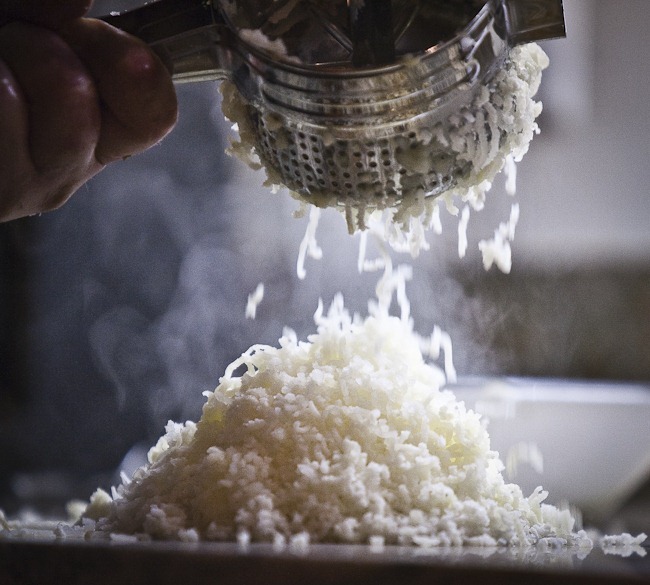
Activity always makes shots more interesting. This can be a challenge in food photography, but yet possible. A spoon stirring in a pot. Steam rising off a freshly cut loaf of bread. A knife slicing through a piece of meat. Flames from a grill. Use your imagination, I am sure you can find some activity (or at least the appearance of activity) to bring to the food.
Tip #5: Eat Well
I don’t know about you, but ply my culinary skills for the purpose of eating it. This implies two things. First, organization and timing are key. If you are cooking a dish, plating it attractively, photographing it, and still want to eat it (and not upset your dinner company), you need to think out the process ahead of time including pre-staging any lighting, props, wine glasses etc. If you do all this, you can still eat well. Professional food photographers generally do not have this end in mind. They are intent on making the food look as good as possible and use a number of tricks to make food look more attractive such as misting or brushing oil onto the food to make it appear juicy and glisten. Not me – the photography is standing between me and a great meal.
The second implication is that you will need to plan your shots – visualizing them before setting the plate down and clicking the shutter. This is good practice independent of the photographic subject, but particularly important if you want to make a good photograph and yet eat while the food is hot.

Come back soon for the next installment of food photography tips. I have a whole pocket full.
Have fun, and go make some great photography.
Craig


