
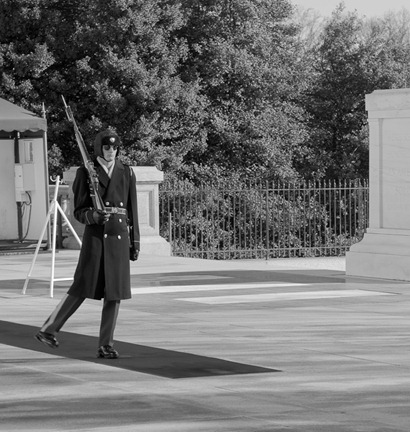
A fundamental aspect of good photography is reflecting the mood or context of your subject. When I think of Arlington National Cemetery in the context of photography, two photographic approaches jump to mind immediately – it must be in black and white, and photographing this sacred place is best done in winter.

Although Arlington National Cemetery regularly boasts some breathtaking colors, I believe the solemn and respectful nature are best represented in black and white. In this case, colors = party, black and white = reverence and respect. Arlington should not be perceived as a place of reverie, it is best viewed as a place of deep reflection.

My second key ingredient is photographing in winter. Barren and apparently lifeless trees add to the stark and contemplative nature of the place. Imagine any of these pictures with trees full of bright green leaves. The image is completely transformed. Not only are the views obstructed, but it becomes a much warmer place. I believe that misses the character of Arlington.

The photographs in this entry were taken early morning under a clear blue sky. This works well because the blue sky becomes a contrast to the white headstones, and the long shadows add further contrast and interest. On the other hand, I have photographed Arlington under completely overcast skies with great results.
With overcast skies, the shadows diminish, contrast decreases, and Arlington becomes even more foreboding. Headstones that do not cast shadows due to the very soft light, are both eerie and transfixing.
I find the next photograph particularly appealing. As framed, the headstone in the foreground stands out as independent from the rest. It makes me wonder if this warrior’s life was similarly independent. I also like the way the Washington Monument subtly peaks through the trees as a comforting force offering comfort to the interned brave.

I am particularly fond of the final photograph. Arlington National Cemetery is an imposing and overwhelming place. As I look across the sea of nearly identical white headstones, I am impressed by the monument to freedom it represents while at the same time feeling a sense of anonymity brought on by the sheer numbers.
This sense of anonymity is clearly represented in this photograph. It captures the headstone of unknown U.S. Soldier number 7300 located in an obscure corner of Arlington. Who is unknown U.S. Soldier number 7300? Where did this soldier serve? Who did this soldier leave to mourn?

So the next time you are shooting, think about what elements of a photograph contribute to the “mood” of your subject. It can make a difference between a good photograph and a great photograph. And the next time you have the privilege of visiting Arlington National Cemetery (or the equivalent in your country), take the time to read the headstones, and reflect – it is a humbling and valuable experience.
Have fun and go make some great photography!
Craig
 Recently I was able to spend a couple of days in New York and spare some time for photography. New York is a photographers playground. At every step there is an interesting view, interesting people, and a constantly changing landscape of light.


